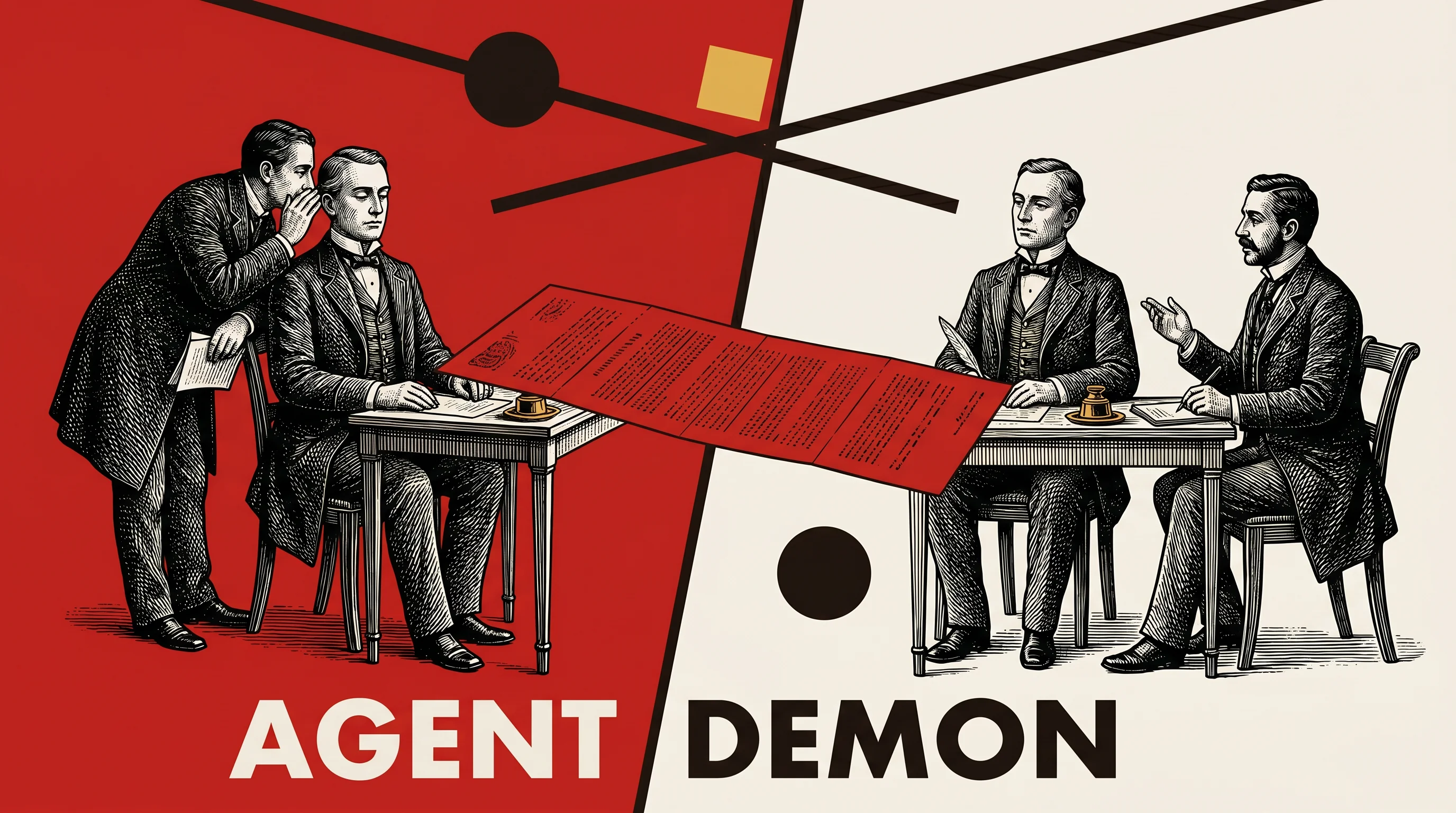
Personal AI agents are about to be standard issue — one or more per employee, the way laptops were in 2005. The question that interests me isn’t whether they show up. It’s how they show up when two humans are talking to each other.
Two structurally different patterns are in play. They look similar from the outside — both produce messages enriched by an agent — but they have opposite consequences for trust, attribution, and how anyone can argue with the agent. Naming them apart is the first step to thinking clearly about which one your team is actually adopting.
Team lead speaks unfiltered. They send a voice-noted fragment, raw, half-finished sentences. The agent intercepts, attaches the project context, runs a quick “you said the opposite on Tuesday” check, and ships a polished message under the human’s name. The recipient’s agent does the reverse: parses the inbound, pulls related artifacts, decides whether to escalate.
On the surface, one message per human turn. The agent is invisible.
Teams already run this pattern in narrow form — AI drafts emails for humans to send, but rarely sends them itself. The line between draft-assist and ship-without-asking is the only thing keeping the org-chart fiction intact: humans are still the only accountable actors — formally, the human said it, signed it, owns the consequences.
The price is that everything the agent does is unauditable. You can’t see what was added, suppressed, or pulled but left out. And there’s no honest way to disagree with your own agent in public — if the contradiction note it inserted was wrong, correcting it means either looking like you contradicted yourself or admitting an agent ghostwrote the message.
Each human has their agent in the conversation as a named participant. I like to call them demons in the classical sense — entities that shadow their human, read everything the human reads, speak on their own line. A two-person DM becomes a four-actor conversation.
Every contribution is attributable and overridable. You can disagree with your own demon publicly — “no, that contradiction note is wrong because…” — which becomes a learning signal the agent can train on.
The downside is loud. Density goes up two to four times. The “always interject” failure mode is real and most early implementations will live in it for a while. Norms about when a demon speaks versus stays quiet don’t exist yet and will have to be invented per team.
Interceptor is harder to implement but easier to adopt. Live-participant is technically trivial and culturally enormous, because it makes the agent’s contribution legible and therefore contestable.
I expect most orgs to start with interceptor and quietly migrate to live-participant. Attribution is one reason — once the agent shows up on its own line, you can correct it, override it, and see what it actually did. The bigger reason may be context: a named agent in the thread is one you can hand fresh context to mid-conversation, instead of hoping the harness loaded the right files. Attribution makes it safe; context-supply makes it useful.
Live-participant fits chat-shaped surfaces. Slack, Telegram, group rooms — attribution is already cheap, density is already high, one more line per actor doesn’t break anything.
Interceptor fits artifact-shaped surfaces. The Linear issue body, the email, the PR description. The unit is the artifact, not the turn. The agent’s job there is to produce one clean output, not to talk about it.
The unsolved problem is the handoff. When a Slack thread decides to file a Linear issue, the same agents have to shift mode. Whose demon writes the first version? Does the other get to review it before filing, or only after? Nobody has a clean protocol yet, and whoever ships one will get more credit than they expect.
The interceptor pattern only has one mature UI today — email autocomplete and AI draft-replies. Live-participant has Slack and the chat surfaces. Everything else is still raw, and the next surface to mature is almost certainly voice. People are dictating more, voicing notes more, talking to their phones more, and the gap between what you say and what the recipient should read is exactly where an interceptor wants to live. I’d expect the first serious voice-interception UI within a year or two. Whoever ships it well will set the conventions for everyone else.